Montessori Vs. Daycare: The Difference for Families
For many families, the choice is not simply “Which school is best?” but “What kind of environment does my child need right now?” Montessori and daycare can both serve children well, but they are not the same. This article explains the real differences in purpose, structure, teaching approach, and family experience so parents can make a clearer, more confident decision.

For families with young children, “Montessori” and “daycare” are often discussed as if they were competing versions of the same thing. In one sense, that is understandable: both may care for children during the workday, both may serve children ages three to five, and both may promise a warm, nurturing environment. But in practice, they are built on different assumptions. Daycare is usually organized first around care, supervision, safety, and the rhythms of family life. Montessori, at least in its authentic form, is organized around a developmental method: a structured educational approach designed to cultivate independence, concentration, coordination, order, and social responsibility through a prepared environment and trained adult guidance.
That does not mean daycare is inferior or that Montessori is always the right choice. Many daycare and preschool programs are warm, thoughtful, developmentally appropriate places where children are well cared for and learn a great deal. The National Association for the Education of Young Children emphasizes that high-quality early childhood programs are built around caring relationships, developmentally appropriate practice, strong family partnerships, and meaningful learning experiences. The more useful question for families is not which label sounds better, but what kind of setting fits their child, their schedule, their values, and their hopes for the early years.
A Difference in Purpose
The first difference is one of purpose. A daycare program is typically designed to provide safe, reliable care for children while parents work, though many programs also include preschool learning experiences, play, and early academic exposure. Montessori schools, by contrast, are designed as educational environments first, even when they also meet full-day childcare needs. In authentic Montessori, the classroom itself is the curriculum: the materials, the layout, the freedom of movement, the sequencing of lessons, the mixed ages, and the uninterrupted work period all work together to support development. The child is not simply being watched, entertained, or rotated through activities. The child is being initiated into a way of working.
That difference in purpose shapes the daily rhythm. In many daycare settings, the day is organized around group activities, transitions, meals, outdoor play, naps, and teacher-led themes. None of that is inherently bad; for many children, predictable routines and social play are a healthy and appropriate fit. NAEYC’s family guidance on high-quality preschool programs highlights warm teacher-child relationships, opportunities for play and friendship, well-planned activities, and inclusive routines as important markers of program quality. Montessori classrooms also have routines, meals, and outdoor time, but the core of the morning is usually an uninterrupted work cycle in which children choose from carefully prepared activities, work independently or in small groups, and repeat tasks until they reach a natural point of satisfaction or mastery.
This is one reason Montessori can feel calmer and more purposeful to visiting families. Children are not being moved as frequently from one adult-planned activity to another. They are learning to initiate, persist, clean up, and begin again. AMS describes the Montessori work cycle as a process in which children choose an activity, complete it fully, return it properly, and experience the satisfaction of finishing meaningful work. That pattern may sound simple, but over time it supports habits that many families care deeply about: attention span, self-direction, responsibility, and follow-through.
The Role of the Guide
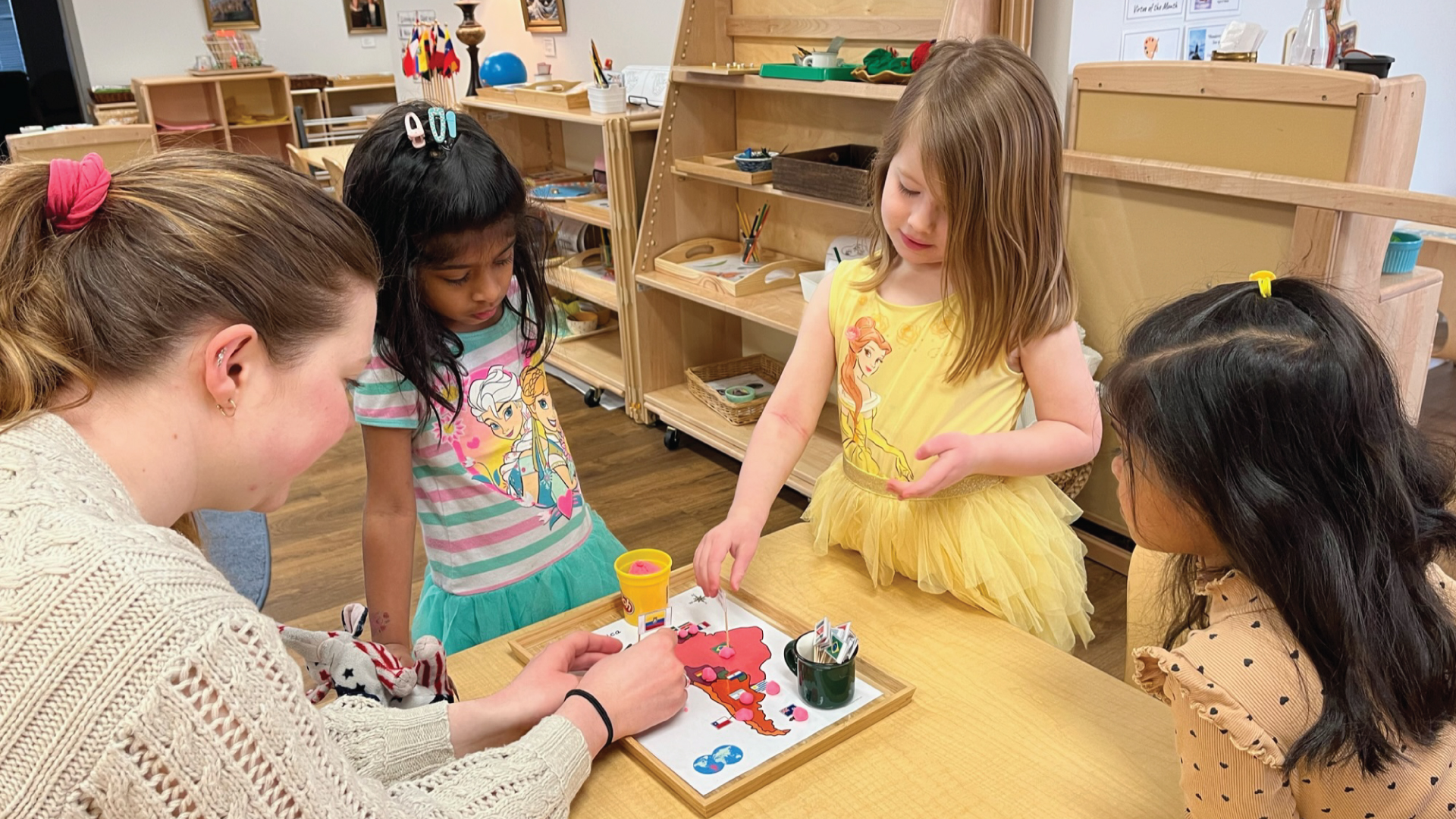
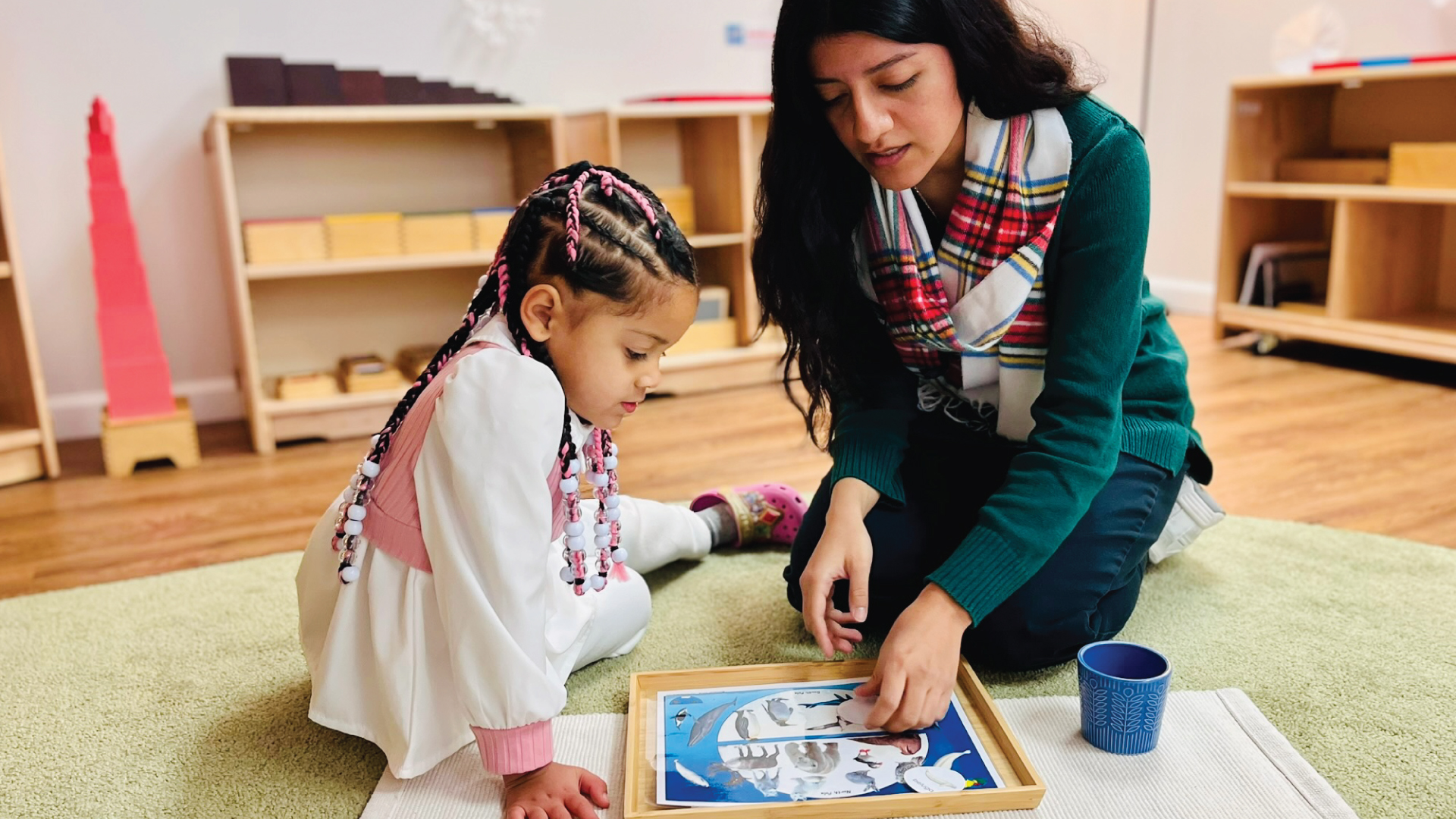
A second major difference is the role of the teacher. In many daycare or conventional preschool settings, the adult is more visibly central: planning group activities, leading songs, managing transitions, and directing the pace of the room. In Montessori, the adult’s role is intentionally more restrained and observational. The teacher (referred to as the “guide”) gives individual or small-group lessons, maintains the environment, carefully watches each child’s development, and intervenes when needed— but ideally does not dominate the room. The point is not adult absence. It is adult precision. Montessori teachers are trained to help children become more independent over time, rather than more dependent on adult prompting.
The Prepared Environment
That teacher role connects to another major distinction: environment. In a typical daycare classroom, children may move among centers, toys, art materials, dramatic play areas, and group rug time. In a Montessori classroom, the environment is more tightly ordered and intentionally sequenced. Materials are displayed on low shelves, usually one complete set of each work is available, and the child is expected to choose, carry, use, and restore the material independently. The room is designed to make independence possible. Montessori organizations describe this as the “prepared environment,” and it is one of the clearest visible differences families notice when comparing programs.
Montessori Sensorial Materials
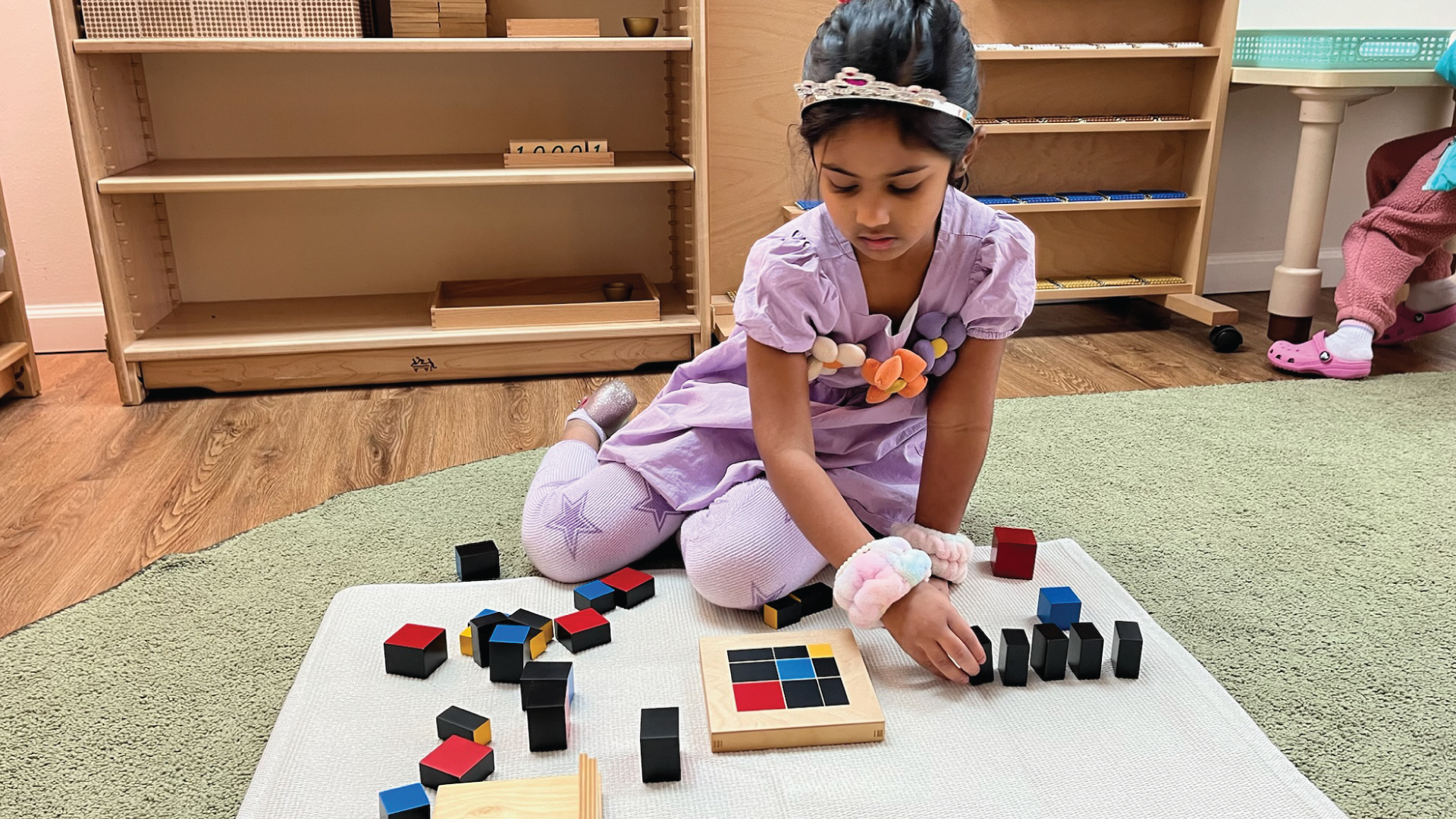
Families often also notice a difference in the kinds of materials children use. Daycare and preschool programs frequently emphasize open-ended play materials, imaginative play, crafts, sensory activities, and themed learning centers. Montessori classrooms use hands-on materials too, but they are more deliberately sequenced and tied to specific developmental purposes. A practical life activity might refine movement and concentration; a sensorial material might isolate one concept such as size, shape, or sound; an early math material might move the child from physical quantity to symbol and then abstraction. The material is not there simply to occupy the child. It is there to help the child build understanding through repeated, purposeful action.
Where Work Is Play
At the same time, families should be careful not to mistake Montessori for a rejection of play or joy. That is one of the most common misunderstandings. NAEYC is right to stress that play is central to early childhood development, supporting language, peer relationships, physical development, and problem solving. Montessori classrooms do not usually look like a conventional play-based preschool, but they are full of movement, exploration, conversation, imagination rooted in reality, and satisfaction in meaningful activity. The difference is that Montessori tends to define freedom less as constant novelty and more as purposeful choice within a structured environment. Some children thrive immediately in that kind of order; others may need a gentler transition into it.
Mixed-Age Classrooms
Another important difference for families is age grouping. Many daycare programs divide children into narrow age bands because licensing structures, staffing models, and developmental expectations are organized that way. Montessori early childhood classrooms, by contrast, typically group children across a three-year span, often ages 3 to 6. AMS identifies the multi-age classroom as one of the core components of Montessori. The benefit is both academic and social: younger children observe what is possible, older children reinforce their learning by helping others, and the classroom becomes more like a community than a same-age cohort moving in lockstep. For some families, this is one of Montessori’s greatest strengths.
True Fidelity Drives Outcomes
What about outcomes? Families understandably want to know whether these differences matter in the long run. The research base is not perfect, and high-fidelity Montessori programs are not always easy to compare with other early childhood settings. Still, a widely cited review in npj Science of Learning concluded that Montessori education has generally shown positive associations with outcomes including executive function, academic skills, vocabulary, and social problem solving, while also noting the methodological limits of the literature. More recent work has continued to explore positive associations in areas such as wellbeing and cognitive functioning. The safest conclusion is not that Montessori is magic, but that its core features are serious enough to merit attention— and that implementation quality matters a great deal.
The Right Choice for Parents
Of course, educational philosophy is only part of the decision. For many families, childcare is also a logistical and financial reality. In the United States, early childhood arrangements vary widely, and participation in school or care settings is common: NCES reports that in 2022, about 59 percent of 3- to 5-year-olds were enrolled in school, with 39 percent in public programs and 20 percent in private education. That means families are often choosing among multiple kinds of programs for overlapping reasons: work schedules, commute, cost, hours, school-year versus year-round calendars, potty-training expectations, meals, nap policies, and availability. A Montessori program may be philosophically attractive, but it still has to fit the actual life of the family.
So how should families think about the choice? A good daycare or preschool may be the right fit if a family’s top priorities are reliable full-day care, a warm social setting, flexible scheduling, and a play-rich environment with strong adult relationships. A Montessori program may be the stronger fit if a family is looking for a more defined developmental philosophy, greater emphasis on independence and concentration, mixed-age community, hands-on materials with a clear sequence, and a classroom culture built around purposeful work rather than frequent teacher-directed transitions. Both can serve children well. The crucial question is whether the program’s daily reality matches its promises.
That is why parents should tour carefully and ask concrete questions. What does the morning actually look like? How much time do children have for uninterrupted activity? How are conflicts handled? Are teachers warm, calm, and observant? Is the room orderly without feeling rigid? Do children appear engaged, or mainly managed? Does the program communicate clearly with families? NAEYC’s family resources and Child Care Aware’s preschool checklist both emphasize looking beyond branding to the lived quality of relationships, routines, teacher practices, and environment. Labels matter less than what a child experiences hour by hour.
In the end, Montessori and daycare are not simply two price points on the same menu. They reflect different ideas about what young children most need from the adults and environments around them. Families do not need to approach that decision with ideology or anxiety. They need clarity. The right question is not, “Which option sounds more impressive?” It is, “Where will my child be known, respected, challenged, and able to grow?” When parents can answer that honestly— after looking closely at the real life of the program— they are much more likely to make a decision they feel good about.